Exploring a Recurrent Neural Network
These notes walk through Andrej Karpathy's minimal character-level Recurrent Neural Network (RNN) implementation. 1
RNNs are special 'lil guysthey reuse the same weights across every timestep while carrying a hidden state, so context flows forward through the sequence because instead of being acyclic, they reuse the same weights across timesteps while carrying a hidden state, so each prediction can use context from previous steps. That makes them especially useful for sequence tasks such as text generation, speech modeling, and frame-by-frame video classification where earlier inputs should influence later predictions.
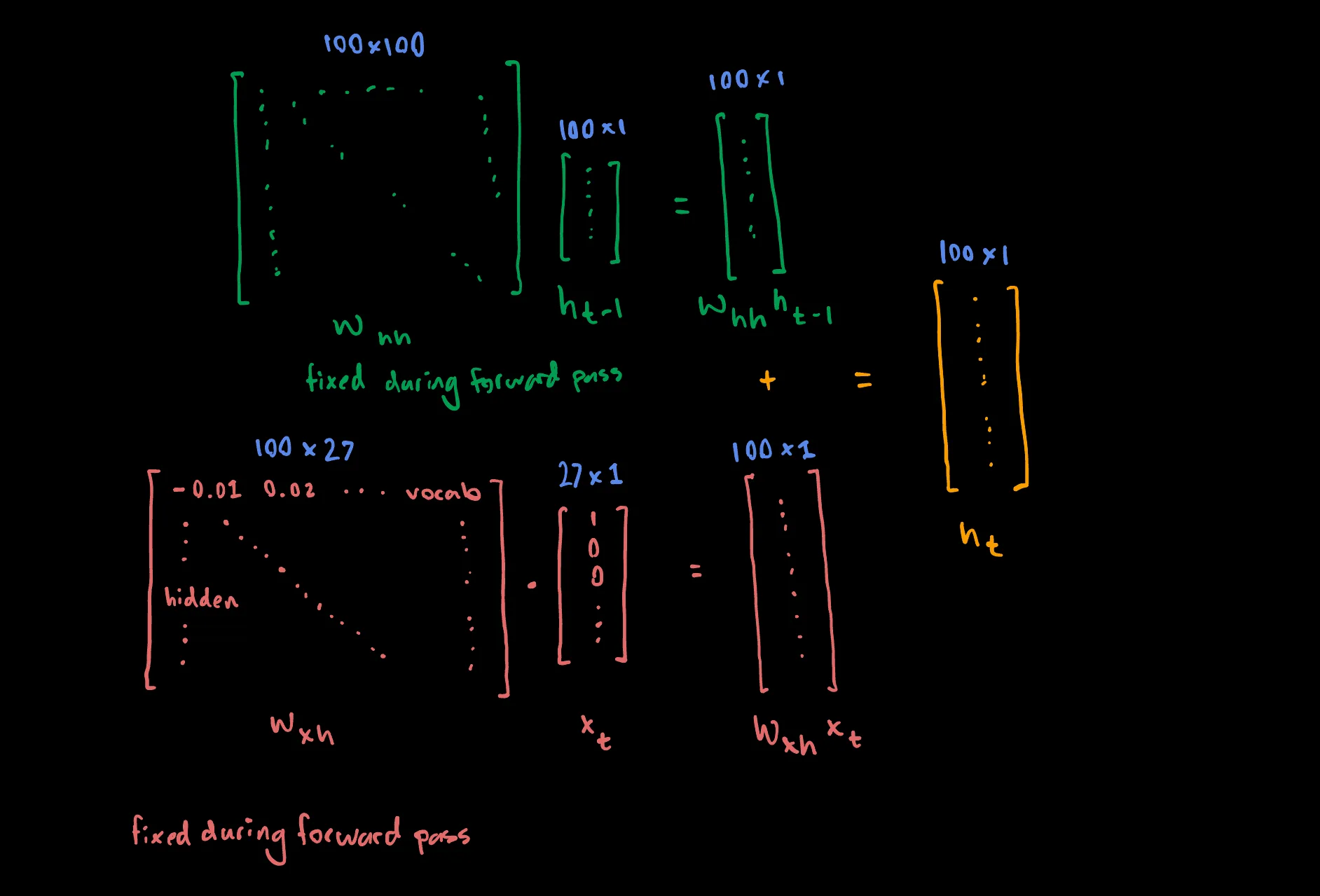
A sequence is just an ordered list over time: characters, words, audio frames, video frames. A timestep is one position in that list. At timestep , the model reads , combines it with , and produces plus a prediction.
Because the same update rule is reused at every step, one RNN can map many different sequence lengths using the same parameters. In this note, we use a character-level many-to-many mapping: each input character predicts the next one. Example: input hello gives shifted targets ello..., so each timestep contributes one prediction and one loss term.
Data I/O#
import numpy as np
# data I/O
data = open('input.txt', 'r').read() # should be simple plain text file
chars = list(set(data))
data_size, vocab_size = len(data), len(chars)
print("data has %d characters, %d unique." % (data_size, vocab_size))
char_to_ix = {ch: i for i, ch in enumerate(chars)}
ix_to_char = {i: ch for i, ch in enumerate(chars)}- Read all characters in the corpus.
- Extract the unique character set, the vocabulary.
- Build lookup maps: character to index and index to character.
Small toy example:

input.txt:
hello

chars = ['h', 'e', 'l', 'o']
data_size = 5
vocab_size = 4
char_to_ix = {'h': 0, 'e': 1, 'l': 2, 'o': 3}
ix_to_char = {0: 'h', 1: 'e', 2: 'l', 3: 'o'}

Larger running example:

hello world is the most commonly used starter program in code today.
it is taught world wide in many many languages which is why is it so famous.
beginners often write it as their very first line of code.
seeing those words print to the screen gives a great sense of accomplishment.
from there, developers move on to more complex topics like loops and functions.
it truly serves as the universal greeting of the programming community.

data_size = 436 characters
vocab_size = 27 unique charactersInitializations#
# hyperparameters
hidden_size = 100  # size of hidden layer of neurons
seq_length = 25  # number of steps to unroll the RNN for
learning_rate = 1e-1

# model parameters
Wxh = np.random.randn(hidden_size, vocab_size) * 0.01  # input to hidden 100 x 27
Whh = np.random.randn(hidden_size, hidden_size) * 0.01  # hidden to hidden 100 x 100
Why = np.random.randn(vocab_size, hidden_size) * 0.01  # hidden to output 27 x 100
bh = np.zeros((hidden_size, 1))  # hidden bias, 100 x 1
by = np.zeros((vocab_size, 1))  # output bias, 27 x 1
seq_length is the number of steps we unroll the RNN before doing
backpropagation. The full dataset can be much larger, so we train on chunks of
25 characters at a time in this implementation.
The weight matrices are initialized to small random values so the network starts with small, non-identical activations instead of a symmetric state.
Main Loop#
n, p = 0, 0
mWxh, mWhh, mWhy = np.zeros_like(Wxh), np.zeros_like(Whh), np.zeros_like(Why)
mbh, mby = np.zeros_like(bh), np.zeros_like(by)  # memory variables for Adagrad
smooth_loss = -np.log(1.0 / vocab_size) * seq_length  # loss at iteration 0
while True:
    # prepare inputs (we're sweeping from left to right in steps seq_length long)
    if p + seq_length + 1 >= len(data) or n == 0:
        hprev = np.zeros((hidden_size, 1))  # reset RNN memory
        p = 0  # go from start of data
    inputs = [char_to_ix[ch] for ch in data[p : p + seq_length]]
    targets = [char_to_ix[ch] for ch in data[p + 1 : p + seq_length + 1]]

    # sample from the model now and then
    if n % 100 == 0:
        sample_ix = sample(hprev, inputs[0], 200)
        txt = "".join(ix_to_char[ix] for ix in sample_ix)
        print("----\n %s \n----" % (txt,))
If the current sequence exceeds the total text length, we reset and start from the beginning of the dataset again.
This first block samples a batch of 25 characters from the dataset:
- Inputs: the indices for
data[p : p + seq_length] - Targets: the indices for the next characters in
data[p + 1 : p + seq_length + 1]
At every timestep, we want the network to predict the character directly following the current one.
Every 100 iterations we call sample to visualize the current predictive power of the RNN.
We then call the loss function:
    # forward seq_length characters through the net and fetch gradient
    loss, dWxh, dWhh, dWhy, dbh, dby, hprev = lossFun(inputs, targets, hprev)
    smooth_loss = smooth_loss * 0.999 + loss * 0.001
    if n % 100 == 0:
        print("iter %d, loss: %f" % (n, smooth_loss))  # print progress
Because training runs on short 25-character chunks, the raw loss from one chunk to the next is noisy. We therefore track an exponential moving average (EMA) so the trend is easier to read.
Conceptually, this line says: keep 99.9% of our historical average, and mix in 0.1% of the new raw loss.
Lastly, we update the parameters with Adagrad:
    # perform parameter update with Adagrad
    for param, dparam, mem in zip(
        [Wxh, Whh, Why, bh, by],
        [dWxh, dWhh, dWhy, dbh, dby],
        [mWxh, mWhh, mWhy, mbh, mby],
    ):
        mem += dparam * dparam
        param += -learning_rate * dparam / np.sqrt(mem + 1e-8)  # adagrad update

    p += seq_length  # move data pointer
    n += 1  # iteration counter
Sample Function#
This function acts as a preview of the RNN's current predictive power.
def sample(h, seed_ix, n):
    """
    sample a sequence of integers from the model
    h is memory state, seed_ix is seed letter for first time step
    """
    x = np.zeros((vocab_size, 1))
    x[seed_ix] = 1
    ixes = []
    for t in range(n):
        h = np.tanh(np.dot(Wxh, x) + np.dot(Whh, h) + bh)
        y = np.dot(Why, h) + by
        p = np.exp(y) / np.sum(np.exp(y))
        ix = np.random.choice(range(vocab_size), p=p.ravel())
        x = np.zeros((vocab_size, 1))
        x[ix] = 1
        ixes.append(ix)
return ixes- At any point during training, we can generate what the model currently predicts the sequence should look like.
- We let it freestyle 200 characters using its current weights.
Operationally, we run a forward pass on the current state of the learned parameters to get a probability distribution over the next character. We sample one index from that distribution, feed that predicted character back in as the next input, and repeat.
In a standard non-recurrent neural network (e.g. Convolutional Neural Networks), if you wanted to process 25 characters, you would need 25 separate hidden layers, each with its own different set of weights.
But in an RNN, we use the exact same three weight matrices Wxh, Whh, and Why at step 1, step 2, step 15, and step 25. This is weight sharing. We are trying to learn the best overall parameters to make inferences at any timestep.
When we first start training, we can glimpse what the RNN is currently capable of predicting:
----
 w nkuebtakl.mx,vbrpra.wfcdvne
r.ymdsubiugslp,ibtc.pstv
bo khd hwp.oknypaefgius.s ksvhxfhhuy,.d bxrt
rueto y,ic
gfhfheui,pcxvxyx bnou,hcvrkuhtvreur.lvd,dfbcxn
 mcblnhtellgey.avfnyyrltgeu,yot.cocposuhrc
----
iter 0, loss: 82.395918
----
It's nothing to write home about, but as one might expect, we see a marked improvement down the line after heavily minimizing our loss:
----
 taught world program in code today.
it is taught world wide in many many languages which is why is it so famous.
beginners print to taugr ag s theit very firse of it as their very farstaline ofveens.
----
iter 33000, loss: 1.283691
----
Loss Function#
In the loss function we compute the forward pass to get the loss, and the backward pass to compute parameter gradients.
def lossFun(inputs, targets, hprev):
    """
    inputs,targets are both list of integers.
    hprev is Hx1 array of initial hidden state
    returns the loss, gradients on model parameters, and last hidden state
    """
    xs, hs, ys, ps = {}, {}, {}, {}
    hs[-1] = np.copy(hprev)
    loss = 0
Forward#
    # forward pass
    for t in range(len(inputs)):
        xs[t] = np.zeros((vocab_size, 1))  # encode in 1-of-k representation
        xs[t][inputs[t]] = 1
        hs[t] = np.tanh(
            np.dot(Wxh, xs[t]) + np.dot(Whh, hs[t - 1]) + bh
        )  # hidden state
        ys[t] = np.dot(Why, hs[t]) + by  # unnormalized log probabilities for next chars
        ps[t] = np.exp(ys[t]) / np.sum(np.exp(ys[t]))  # probabilities for next chars
        loss += -np.log(ps[t][targets[t], 0])  # softmax (cross-entropy loss)
We receive the 25 input targets and iterate through them from left to right.
- Start at
t = 0 - Create
xs[t]as a zero vector - One-hot encode the current character index into that vector
Then we compute the recurrence:
Using the dictionaries defined at the start of the function, we cache hidden states for every timestep in the 25-step window. Backpropagation needs these cached values, while inference during sampling does not. In each iteration, gradients are computed only over the current 25-character window; the next iteration advances to the next window. This is Truncated Backpropagation Through Time.
We now have the logits in ys[t], which are normalized by softmax and turned into a distribution over the next character.
The total chunk loss is just the sum of the per-timestep prediction errors, and that accumulated loss is what drives one parameter update for the whole window.
Backward#
    # backward pass: compute gradients going backwards
    dWxh, dWhh, dWhy = np.zeros_like(Wxh), np.zeros_like(Whh), np.zeros_like(Why)
    dbh, dby = np.zeros_like(bh), np.zeros_like(by)
    dhnext = np.zeros_like(hs[0])
    for t in reversed(range(len(inputs))):
        dy = np.copy(ps[t])
        dy[targets[t]] -= 1  # backprop into y
        dWhy += np.dot(dy, hs[t].T)
        dby += dy
        dh = np.dot(Why.T, dy) + dhnext  # backprop into h
        dhraw = (1 - hs[t] * hs[t]) * dh  # backprop through tanh nonlinearity
        dbh += dhraw
        dWxh += np.dot(dhraw, xs[t].T)
        dWhh += np.dot(dhraw, hs[t - 1].T)
        dhnext = np.dot(Whh.T, dhraw)
    for dparam in [dWxh, dWhh, dWhy, dbh, dby]:
        np.clip(dparam, -5, 5, out=dparam)  # clip to mitigate exploding gradients
    return loss, dWxh, dWhh, dWhy, dbh, dby, hs[len(inputs) - 1]
We iterate backward through timesteps, propagating gradients through the unrolled network.
Backprop Through Softmax#
dy = np.copy(ps[t])
dy[targets[t]] -= 1
Recall that in this example we have total classes, one for each unique character in the dataset.
During the forward pass, at each timestep , we compute logits over all classes :
If the target class index is , the per-timestep loss is:
The total sequence loss accumulates across timesteps as , which is exactly what loss += -np.log(ps[t][targets[t], 0]) computes.
The generic categorical cross-entropy expression is:
Because the target distribution is one-hot, all terms vanish except the correct class term, giving us:
Now, during backprop for dy, we chain gradients from the loss back to the logits at timestep :
Keeping fixed and only writing class indices and :
Step 01: Gradient of the loss with respect to the softmax probability of the correct class :
Only the correct-class term contributes directly to the loss because the targets are one-hot.
Step 02: Gradient of the softmax output with respect to logit :
The softmax Jacobian has two cases:
If is the target class, the gradient encourages increasing . If is not the target class, increasing pulls probability mass away from the target class, so the sign flips accordingly.
Step 03: Combine the pieces with the chain rule:
Substituting the two cases gives:
So the target class gets , and every non-target class gets . That is exactly the compact update used in code.
Visually:
From there, the backward pass continues through Why, the tanh nonlinearity, and finally the hidden-to-hidden and input-to-hidden pathways. The implementation then clips gradients to the range [-5, 5] to reduce the risk of exploding gradients.
Closing Notes#
I kinda got lazy at the end and didn't wanna keep writing latex, so I decided to call it a night, but hopefully this was useful ;P
Footnotes#
-
Implementation: https://gist.github.com/karpathy/d4dee566867f8291f086 ↩